
Criminal Court Cases in Cabarrus County
Cabarrus County criminal cases belong to the North Carolina General Court of Justice. District Court handles misdemeanors and infractions, along with the first stages of felony matters. Superior Court has felony trial jurisdiction and hears felony pleas and sentencing. One Clerk of Superior Court keeps both divisions' files. That unified setup means a person does not need to locate separate city, county, and district clerks to follow one criminal case.
The court file begins with a citation, summons, warrant, magistrate order, or other charging process. A felony can later move through probable-cause work, waiver, and grand jury action before it reaches Superior Court. The prosecutor may amend counts, and each charge can reach a different result. Cabarrus County court records should therefore be read charge by charge, not just by the case caption or the first allegation shown.
The Cabarrus court contact directory identifies the clerk, magistrate, prosecutor, and court units that support these cases.
The directory helps a reader send a docket, process, or scheduling question to the office that owns that part of the Cabarrus County case.
Cabarrus Court Records by Division
The court division tells a reader where a matter sits in its path. It does not create a new records office. Both divisions operate through the same clerk at the Cabarrus County Courthouse, and both use the statewide eCourts framework.
| Court or Unit | Role in a Criminal Case | Records Point |
|---|---|---|
| District Court | Misdemeanors, infractions, and early felony proceedings | Clerk of Superior Court |
| Superior Court | Felony indictments, trials, pleas, and sentencing | Clerk of Superior Court |
| Magistrates | Initial process, appearances, and release conditions within their authority | Magistrate or filed clerk record |
| District Attorney | Charging, plea, and trial decisions for state cases | Court docket and filed papers |
| Administrative Traffic Court | Qualifying citation matters on first and third Fridays | District Court case file |
Concord, Kannapolis, and Harrisburg do not have municipal criminal courts. City ordinance citations and state misdemeanors go into District Court. The offense location still matters for Kannapolis because that city extends into Rowan County. Choose Cabarrus only when the filed case belongs here.
Cabarrus County Case Record Searches
The free North Carolina eCourts Portal is the broad online starting point. Smart Search supports party and record identifiers, while hearing search can use a case, party, lawyer, judge, courtroom, or date. A name search should be narrowed to Cabarrus County and checked against lawful case details. A same-name result alone does not confirm identity.
- Open Smart Search. Use the case number when known, or enter a party name and select Cabarrus County as the location.
- Apply criminal or infraction filters when the interface offers them. Compare middle initials, filing dates, and charge context.
- Open the case-number link. Review each charge, event, hearing, balance, and available public document.
- Check the official Court Dates tool or Cabarrus calendars for the next setting. Treat a calendar as a schedule, not an outcome.
- Call or visit the clerk for a missing scan, an archived file, plain or certified copies, or an authoritative disposition.
- Ask about the current copy and certification cost before ordering. A certified county or statewide clerk search has a published $25 fee.
| Field Label | Type | Required | Notes |
|---|---|---|---|
| Search selector | Tabs or menu | Yes | Choose Smart Search or Search Hearings. |
| Search Criteria | Text | Yes | Party name or record number; the FAQ lists other identifiers. |
| Location | Dropdown | No | Select Cabarrus County to reduce statewide same-name results. |
| Case category or type | Dropdown | No | Choose criminal, infraction, or a displayed subtype. |
| Party status or date | Filters | No | Use filters shown in the current Portal release. |
| Case-number link | Result link | No | Opens the register of actions and case summary. |
Portal may expose document, payment, or action tabs only when the case and public-access rules allow them. A blank tab is not proof that no filing exists. Save the case number and ask the Cabarrus County clerk about the specific record.
Missing Cabarrus Court Documents
A Portal case can be real even when no scanned pleading appears. Public document depth varies, especially after the statewide Odyssey conversion and for older retained files. Some items are available only at a courthouse terminal or from the clerk's electronic or paper file. Sealed, confidential, juvenile, and victim-sensitive items will not become public merely because a request is made.
Start with the case number and name the exact item needed, such as a judgment, charging paper, or motion. The clerk is at 61 Union Street South, Concord, NC 28025, with mail directed to PO Box 70, Concord, NC 28026. The main number is 704-262-5500, and ordinary office hours are Monday through Friday, 8 a.m. to 5 p.m. Ask whether the record can be inspected, copied, or certified and whether it is stored outside the current electronic view.
The official clerk criminal-record search page explains why a formal name-based check differs from a free Portal review.
This distinction matters when a reader needs a certified result rather than a screen view of Cabarrus County case data.
What a Criminal Case File Contains
A Cabarrus County criminal case file records the prosecution, not the full police investigation or every jail event. Public Portal details and clerk files can identify the charge sequence, court events, lawyers, judgments, and financial entries. The arresting agency retains its own incident material, and the sheriff keeps any booking record. Those separate files may use different numbers.
| Case Number and Court | The unique court record, Cabarrus location, division, filing date, type, and status. |
|---|---|
| Charging Document | The citation, complaint, warrant, magistrate order, indictment, or other filed accusation. |
| Parties and Counsel | Public defendant, attorney, prosecutor, and judicial-officer information where displayed. |
| Docket Events | Service, appearances, motions, continuances, plea events, failures to appear, and appeal entries. |
| Hearing Dates | Scheduled date, time, courtroom, hearing type, and judicial officer when public. |
| Disposition and Judgment | The outcome for each charge, plea, conviction or dismissal, judgment, and sentence. |
| Financial Record | Public assessments, payments, costs, fines, and balance information where available. |
Dates and charges in an arrest or jail entry can differ from this filed sequence. For a final answer, inspect the judgment or obtain a clerk-certified disposition rather than relying on a booking description.
Reading Cabarrus Case Dispositions
Portal presents charge-level results, so one case may contain a conviction, a dismissal, and a count still pending. “Disposition” means the recorded outcome of a charge. A nolle prosequi records the prosecutor's choice not to proceed on that count at that time. A prayer for judgment continued, often called a PJC, delays entry of final judgment and is not simply another word for dismissal.
- Pending
- The court has not entered a final outcome for that charge; the label does not prove guilt.
- Dismissed
- The charge ended without a conviction in that case, though the arrest entry may remain unless lawfully expunged.
- Guilty
- A plea or finding of guilt was entered, followed by judgment and any sentence shown.
- Failure to appear
- The court recorded a missed setting; an order for arrest or added consequences may follow.
- Appeal
- A later court is asked to review the judgment under the route allowed for that case.
Read the event date beside each label. Then compare the final judgment and later appeal or compliance entries. If shorthand is unclear, the clerk can identify the filed document that controls the Cabarrus County court record.
Criminal Case Stages in Cabarrus County
A misdemeanor normally remains in District Court unless a lawful appeal changes the forum. A felony starts with initial process and District Court work, then may proceed by waiver and indictment to Superior Court. Plea talks, motions, or continuances can alter the sequence. No fixed time promise fits every Cabarrus County criminal case.
Case flow: Charges Filed › Arraignment › Pretrial › Plea or Trial › Disposition › Sentencing
Initial release conditions and later bond rulings are docket events, but they are not the final case result. Local bond policy and interim pretrial orders can affect those entries. Appeals, probation review, and compliance events may continue after sentencing, so the last visible event is worth checking before treating a case as closed.
The Cabarrus local rules and forms page publishes court orders that can shape process and access.
Checking the current order keeps an older bond or device rule from being mistaken for present Cabarrus County practice.
Cabarrus Court Calendars and Technology
Court dates answer where and when a case is set. They do not show the final result. Cabarrus County also publishes local Superior and District Court calendars, probation calendars, Administrative Traffic Court information, and Webex links. A date can move, while a calendar entry may remain a snapshot of what had been planned.
The statewide North Carolina Court Dates search offers name, citation, county, and date routes.
Use that result to locate a setting, then return to the case docket or clerk for the Cabarrus County outcome.
Local technology explains some unusual event descriptions. Cabarrus demonstrated CRAVE audiovisual court tools for hearings linking the jail and other sites, maintains remote-court links, and received a public eCourts kiosk in June 2025. All North Carolina counties completed Odyssey conversion in October 2025. The kiosk can support scanning, printing, and payments, but it does not replace the clerk as custodian of the underlying case file.
The local administrative schedules page groups the county's current calendar links.
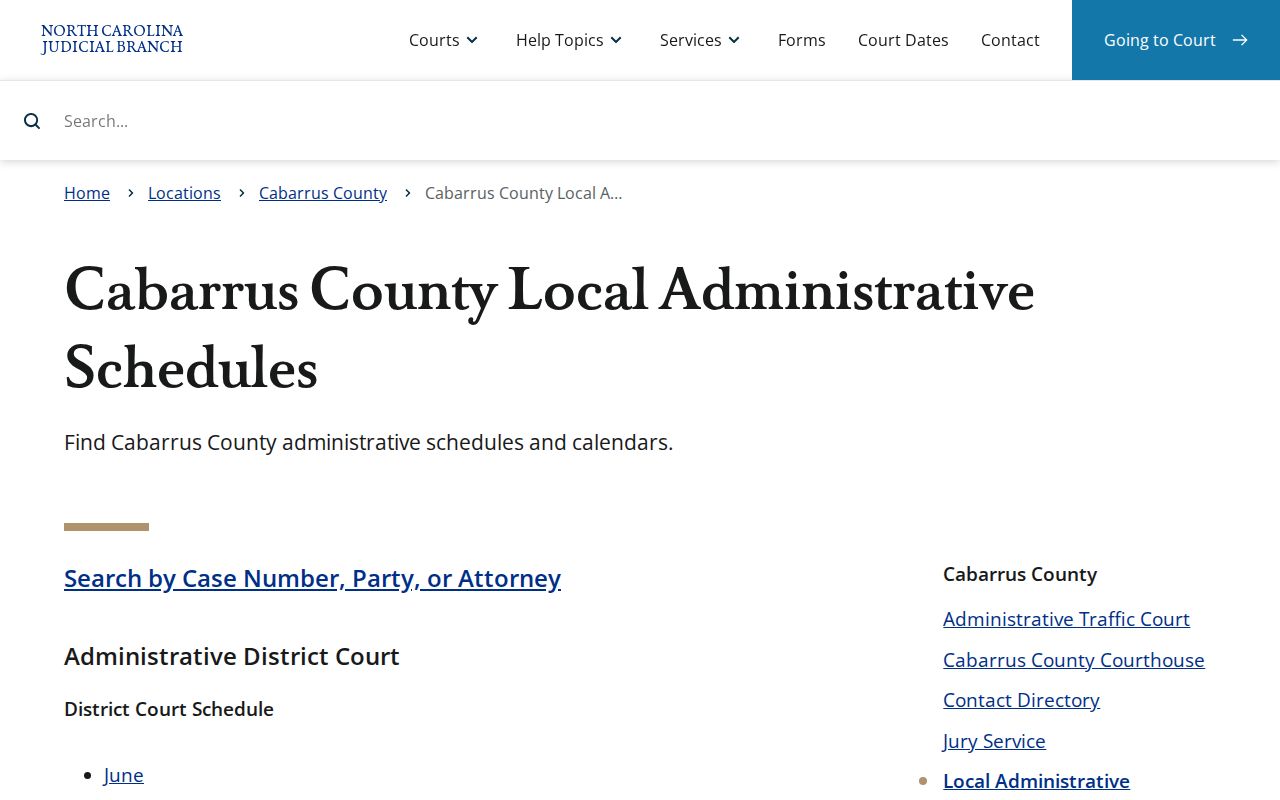
Its date-specific listings help distinguish a scheduled Cabarrus County appearance from a judgment already entered.
Access Rules for Case Records
North Carolina law generally directs clerks to make court records available at reasonable times. G.S. 7A-109 supplies that court-record rule, while the North Carolina Public Records Law governs many agency records. The distinction matters. A court file may be public even though the police narrative or evidence behind it is not open as a whole under G.S. 132-1.4.
Online access can be narrower than access at a public terminal or clerk counter. Ask the clerk about a Cabarrus County case that does not appear, but do not assume absence means dismissal or expunction. Historical conversion, spelling, a different county, or a protected case may explain the gap. For broader county criminal-history channels beyond a case file, use the Cabarrus County criminal history overview.
Cabarrus Court Terminal Searches
The courthouse terminal can search more than a defendant name. Cabarrus County public terminals accept a case number, victim name, or witness name as well. This can help when the Portal result is hard to locate or when the requester has a record number from a notice. The clerk can then point to available electronic or retained paper material.
Plan a visit with the local security rules in mind. The Cabarrus courthouse page lists cell phones among prohibited items, and bags may be searched. A person who planned to photograph a record may need to take written notes or buy copies instead. The local electronic-device order took effect in August 2025, so confirm the current order before arriving. Do not assume a public record grants permission to bring a device into the building.
Note: Ask the clerk about current per-page and certification charges before requesting copies, since the published $25 search fee does not include every document cost.