
Concord Criminal History Checks
Begin with the Concord event, not a broad name search. A recent Concord incident belongs first with Concord Police. A Concord detention question belongs with Cabarrus Sheriff Police-to-Citizen, and a filed Concord charge belongs in North Carolina eCourts. These Concord sources describe different stages. A Concord police report records an allegation and response. A booking entry records intake and current custody. A court docket records what prosecutors filed and how the judge resolved each count.
Use a narrow set of Concord facts: the full name, event date, location, incident number, or case number. Then compare identity and charge details before treating two Concord results as the same person. For an official Concord outcome, contact the Cabarrus Clerk of Superior Court at 704-262-5500. For one's own fingerprint-indexed state history, the North Carolina State Bureau of Investigation offers Right to Review rather than a public name portal.
- Identify whether Concord Police, another agency, or the sheriff created the first record.
- Check the city report channel or county booking inquiry for the recent event.
- Search eCourts with Cabarrus County selected and confirm the result with the clerk.
- Use SBI Right to Review only for your own fingerprint-based North Carolina history.
- Compare the agency, case, and disposition records before treating the search as complete.
Concord Police Record Portals
Concord Police links both Police-to-Citizen and an online report option. Concord online reporting is limited to eligible nonemergency events. Active Concord crimes and emergencies still go to 911. P2C can help locate public Concord police information before a call to Records, but its result is not a court judgment. Concord charges can change when a prosecutor reviews the facts, and a court may later dismiss, amend, or resolve a count.
The official Concord Police records page shows the city's record and reporting routes. The image below preserves that source context.
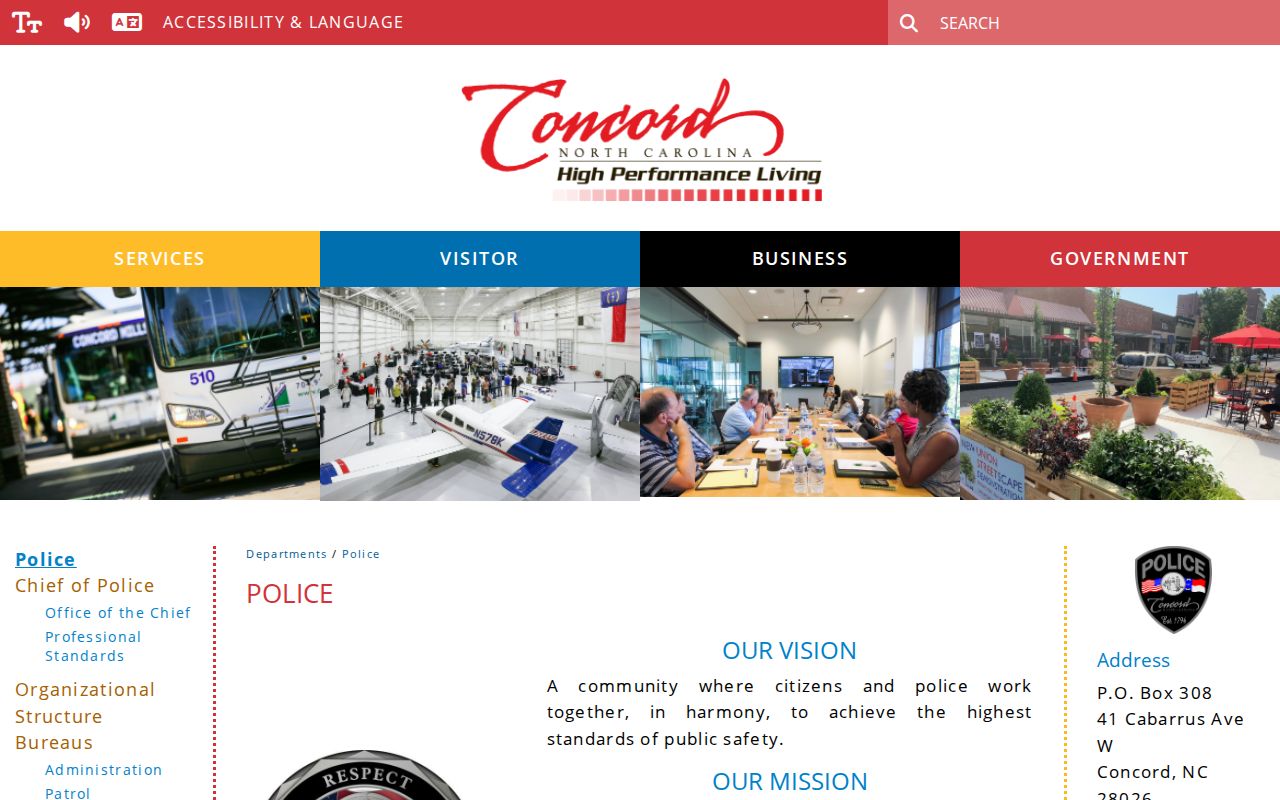
That Concord page is the correct starting point for a CPD incident, while a later Concord disposition must be checked through the Cabarrus court file.
Records at Concord Police
Concord Police Records is at 41 Cabarrus Avenue West, Concord, NC 28025, and its direct number is 704-920-5052. Customer Service lists 704-920-5000 and 704-920-5018, while nonemergency communications uses 704-786-9155. Ask Records for the public portion of an incident or arrest record and give a tight date, place, subject name, and incident number if known. Do not ask the city for a certified court disposition because the clerk, not CPD, maintains that file.
Concord Police Records
41 Cabarrus Avenue West
Concord, NC 28025
704-920-5052
City incident, arrest, report, and police-record questions.
A Concord mailing address alone does not establish CPD jurisdiction. The city covered 63.48 square miles in the 2020 Census geography, and nearby addresses may fall under the sheriff or another agency. Check the agency name printed on the report before making the request.
Concord 911 Record Requests
Concord Police Records and Concord Emergency Communications are separate custodians. A request for a Concord police incident face sheet is not the same as a request for a Concord 911 call or computer-aided dispatch record. Concord Emergency Communications posts its own public-record route for 911 material. State law permits access to defined 911 content after protected caller, victim, witness, and personal details are removed.
The official communications page appears below because it is the source for this city-only access path.
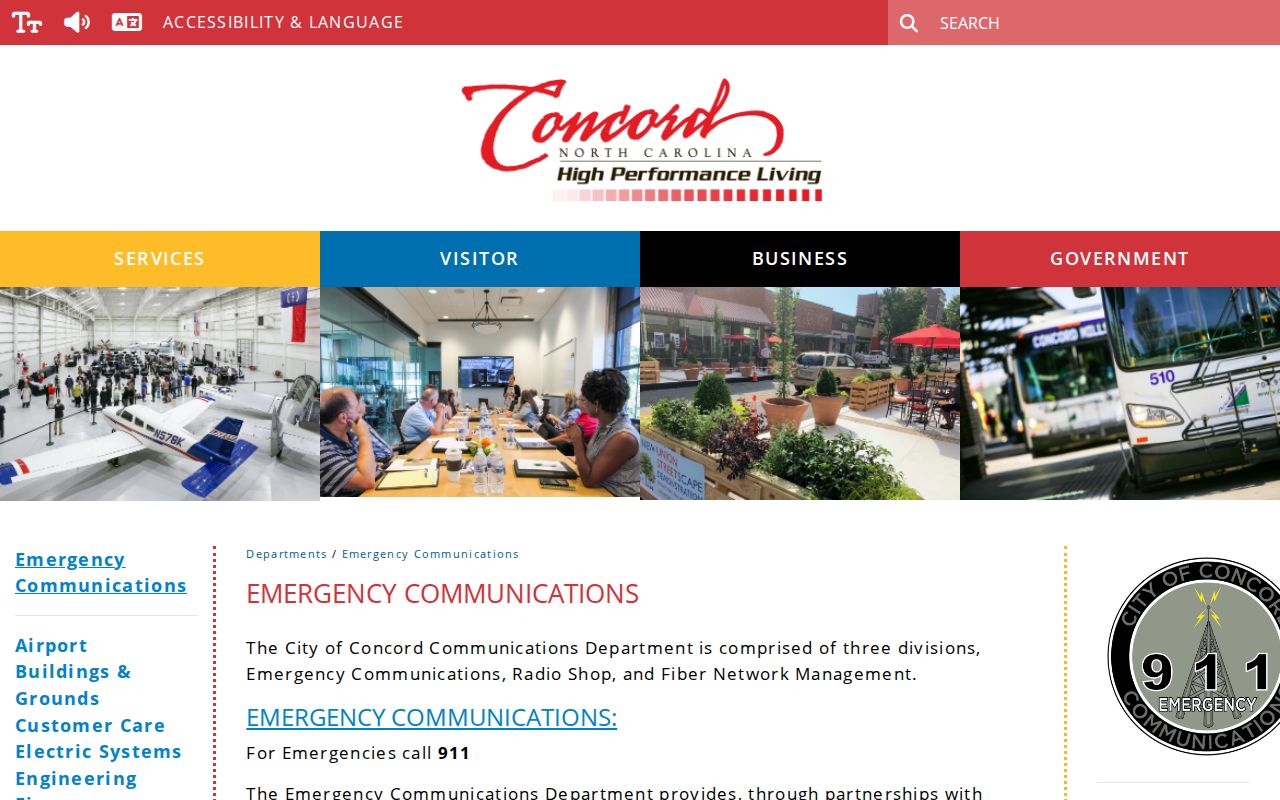
The separate Concord desk matters when P2C shows an event but does not supply the Concord call audio, CAD detail, or requested dispatch record.
| Police report | Ask Concord Police Records for releasable incident or arrest material. |
|---|---|
| 911 or CAD | Use Concord Emergency Communications and describe the call date, time, and place. |
| Filed case | Use eCourts and the Cabarrus Clerk of Superior Court. |
Booking and Arrest Records in Concord
Concord does not operate a standalone long-term city jail for these searches. When a Concord arrest requires detention, the Cabarrus County Sheriff creates the Concord booking and custody entry. Search the official Cabarrus P2C Inmate Inquiry by name for current custody. An empty result means only that the person is not currently listed. It does not erase the Concord arrest, show that no case was filed, or establish the final outcome.
The agency report stays with CPD. The jail record stays with the sheriff. The filed criminal case stays with the clerk. This division explains why dates and charge labels may differ across Concord arrest records. For historical booking facts not visible online, contact Detention Services at 65 Church Street South or 704-920-3058. The broader Cabarrus arrest search covers county custody channels in more depth.
Record path: CPD arrest › Cabarrus booking › magistrate and clerk file › court disposition.
Concord Custodial Video Records
Concord body-worn and dashboard recordings do not follow the ordinary copy rule. Concord's VR-1 form asks for the requester's name, signature, birth date, home address, telephone numbers, and the Concord incident date, approximate time, and location. It also makes a key distinction. Disclosure means authorized viewing or listening. Release means obtaining a Concord copy for wider use and generally requires an order from Superior Court under G.S. 132-1.4A.
For a recording that depicts death or serious bodily injury, Concord directs an eligible requester to the notarized AOC-CV-275 process. The agency then follows a set petition and court-review schedule. This is more exact than sending a broad email labeled as a public-record request. A narrow form with the event facts gives the custodian a sound way to locate the recording.
- Disclosure
- Viewing or listening by a person authorized under the recording statute.
- Release
- Providing a copy under the court-order process.
- Public incident facts
- The limited front-page facts identified in G.S. 132-1.4.
The Concord Municipal Court File
No Concord municipal criminal court exists. Concord ordinance charges, Concord traffic matters, and state misdemeanors are handled in Cabarrus District Court. Concord felonies move through preliminary District Court work and then Superior Court when prosecuted at that level. Both divisions belong to the unified North Carolina General Court of Justice, and the Cabarrus Clerk of Superior Court maintains both sets of Concord files.
Use the North Carolina eCourts Portal with Cabarrus County selected, then call or visit the clerk for an authoritative copy or disposition. Administrative Traffic Court on the first and third Fridays is also a county and state court service. It is not a city tribunal, even when the citation arose in Concord.
| Court | Cabarrus District Court for misdemeanors, infractions, and preliminary felony work; Superior Court for felonies. |
|---|---|
| Record Holder | Cabarrus Clerk of Superior Court. |
| Search Method | eCourts Portal, courthouse terminal, or clerk request. |
| What the Docket Shows | Charges, hearings, events, disposition, sentence, costs, and available public documents. |
| Copies & Fees | Ask the clerk for current copy charges; a certified county or statewide clerk search is listed at $25. |
Concord Record Identity Checks
The Census Bureau estimated Concord at 112,395 residents in 2024, up from 105,240 in the 2020 Census. Growth raises the chance of same-name matches in a city and statewide court portal. A name alone is weak proof. Compare the county, middle name or initial, case number, filing date, charge, and event location before drawing any conclusion.
Crime totals also need a clear denominator. Concord Police figures should be labeled by agency, reporting year, and coverage. Do not blend CPD, sheriff, and other agency counts as though each serves the same city boundary. Population data helps explain search risk, but it does not identify a person in a criminal record.
How Concord Records Reach the County
A Concord officer creates the first incident or arrest record. If the person is jailed, Cabarrus Detention creates a separate booking file and captures intake data. Magistrates and the clerk create court process. Prosecutors may change the filed charges, and the final court disposition then feeds the SBI criminal-history repository when properly linked to the fingerprint arrest cycle.
Record flow: Concord Police Department › Cabarrus County Courts › North Carolina State Bureau of Investigation.
Recent city activity is most likely to appear first with CPD or P2C. A later, fully processed case belongs in eCourts and the clerk file. An SBI Right to Review report serves a different purpose: it lets the subject inspect their own fingerprint-linked state history. If that history lacks a disposition, obtain the certified Cabarrus result and follow SBI's correction process.
Concord Criminal Case Help
A person charged in Concord may need representation, but a Concord police records clerk and the district attorney cannot provide neutral legal advice. North Carolina Indigent Defense Services administers the appointed-counsel system. Eligibility in a Concord case is decided through the court process, based on the required financial affidavit and judicial review.
The official North Carolina Indigent Defense Services source is shown below to distinguish record access from legal representation.
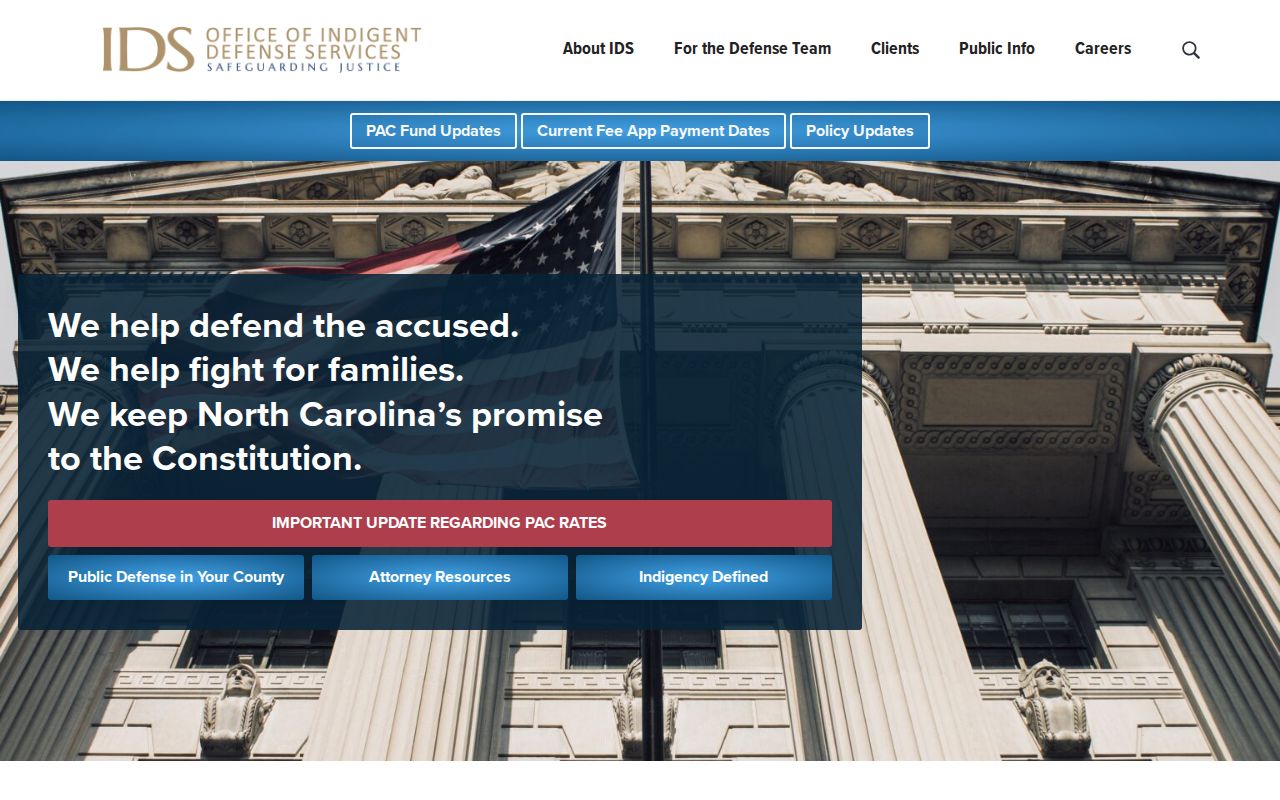
The page supports the local case route but does not replace the Cabarrus clerk as custodian of the docket or judgment.
Concord Record Access Rules
North Carolina Public Records Law starts with access to government records, but criminal records have specific limits. G.S. 132-1.4 makes listed front-page facts public while excluding criminal intelligence and investigative files as a whole. Those public facts can include the reported time, date, place, nature, alleged violation, and defined arrest circumstances. Narratives, witness statements, juvenile data, protected identifiers, and active investigative material may be withheld.
Key Statutes:
North Carolina Public Records Law sets the state's general public-record framework.
G.S. 132-1 defines public records and their broad forms.
G.S. 132-1.4 separates public arrest facts from protected investigative material.
Ask for the exact Concord record and format needed. A focused request is easier to process and less likely to sweep in protected data. If access to a recording requires a court order, follow G.S. 132-1.4A instead of treating the item as an ordinary police report.
Confirm Concord Record Jurisdiction
Concord location is the last check before relying on a Concord result. A Concord mailing address may sit outside CPD's actual service area. Highway Patrol may hold a Concord roadway report, campus police may hold an institution report, and the sheriff may have handled an event near Concord. The Concord booking may still appear in Cabarrus P2C even when CPD did not make the arrest.
Read the agency field first. Then request the originating report from that agency and use Cabarrus eCourts for the filed county case. This small check prevents wasted calls to Concord Records and keeps a police incident number from being confused with a state court case number. It also preserves the key distinction between a city allegation, county custody, and a final judicial result.